Thursday, September 3, 2009

Hardware


HTC opted for resistive technology for the touchscreen but not capacitive. The reason cited by Horace Luke, HTC's Chief Innovation Officer, was that the resistive touch screen is better for Asian character recognition.[12] However, the buttons beneath the screen, as well as being pressable buttons, have capacitive touch sensitivity. This feature is used by the camera application to auto-focus the camera as a finger approaches to press the button that will take a picture.[13]

Luke also noted that this is the thinnest device that HTC has designed to date.[14]

Some people find that the Touch Diamond's battery life is too short to suit their needs, although it is possible to greatly extend this with an upgrade to the 'radio rom'. Consequently, batteries offering double the capacity of the included battery are being sold by third parties and HTC itself sells an extended battery with 50% extra capacity. [15][16]

The screen turns itself off when a person is on a call. This is to prevent the screen accepting unwanted inputs from the user's face when they are making a call, but it also requires the user to turn the screen back on if they want to use the screen. Removing the stylus when in a phone call both turns on the screen and starts up the notes application. [17]

HTC Touch Diamond

The HTC Touch Diamond, also known as the HTC P3700 or its codename the HTC Diamond[1], is a Windows Mobile 6.1-powered Pocket PC designed and manufactured by HTC. It is the first device to feature TouchFLO 3D - a new version of the TouchFLO interface, unique to the Touch family.[2] The HTC Touch Diamond was first available in Hong Kong in late May 2008.[3][4] It was available across all major European carriers in June 2008, and will be available later in the year in other parts of the world[5]. The American Touch Diamond was launched on September 14 2008 on the Sprint[6] network, and April 10, 2009 on the Verizon Wireless network[7]. The European release date was slightly delayed by a last-minute ROM update.[8] The carrier bound names for this phone include T-Mobile MDA Compact IV[3], O2 XDA Diamond[9] and O2 XDA Ignito.[10] It is the official successor of the HTC Touch.[11] The successor to the Touch Diamond - the HTC Touch Diamond2 - was announced in February 2009 for Q2 2009 release outside the US and Q4 release estimated for North America.

Imperial State Crown


The Imperial State Crown is one of the British Crown Jewels.

The Crown is of a design similar to St Edward's Crown: it includes a base of four crosses pattée alternating with four fleurs-de-lis, above which are four half-arches surmounted by a cross. Inside is a velvet cap with an ermine border. The Imperial State Crown includes several precious gems, including: 2,868 diamonds, 273 pearls, 17 sapphires, 11 emeralds, and 5 rubies.

The Crown includes several famous jewels. The Cross atop the Crown is set with a stone known as St. Edward's Sapphire, a sapphire taken from the ring (or possibly coronet) of Edward the Confessor. The Black Prince's Ruby (actually a spinel) is set on the front cross pattée. Furthermore, the famous Cullinan II, or Lesser Star of Africa, is set on the front of the Crown. The back of the crown is set with the 104 carat (20.8 g) Stuart Sapphire in its band, directly above Cullinan II, is the Koh-i-Noor, which was once set into the tiara of the Queen Mother, and until recently, kept separate from the rest of the Crown Jewels, the Koh-i-Noor was placed into the Imperial State Crown shortly after the death of the Queen Mother in 2002.

Imperial State Crown


It is generally worn at the end of a coronation when the new monarch departs from Westminster Abbey and is not normally the actual crown used at the moment of coronation. However it was actually worn during the ceremony by Queen Victoria and King Edward VII, both of whom complained about the weight of the normally used crown, St Edward's Crown.

The Imperial State Crown is worn annually by the Queen at the State Opening of Parliament. Traditionally, the Crown and other jewels leave in their own carriage and arrive at the Palace of Westminster prior to the Queen's departure from Buckingham Palace. They are then transported to the Robing Room, where the Queen dons her robes and wears the Crown.

The current Imperial State Crown was manufactured for the coronation of King George VI in 1937 by the Crown Jewellers Garrard & Co. It is an exact replica of the earlier Imperial State Crown manufactured for Queen Victoria, but is of a more lightweight design and less uncomfortable to wear. The same Crown was remodelled for Queen Elizabeth II’s coronation to give it slightly more feminine appearance and its total height lowered by about one inch (2.54cm). Because of its weight (910 g), monarchs often choose to wear the Imperial State Crown in their private apartments on and off for a couple of hours on the morning of the State Opening of Parliament so they can get used to the weight and feel comfortable with it on. (One courtier reported on the morning of a State Opening witnessing Queen Elizabeth eating her breakfast and reading newspapers while wearing it.)

Imperial State Crown


The Imperial State Crown is one of the British Crown Jewels.

The Crown is of a design similar to St Edward's Crown: it includes a base of four crosses pattée alternating with four fleurs-de-lis, above which are four half-arches surmounted by a cross. Inside is a velvet cap with an ermine border. The Imperial State Crown includes several precious gems, including: 2,868 diamonds, 273 pearls, 17 sapphires, 11 emeralds, and 5 rubies.

The Crown includes several famous jewels. The Cross atop the Crown is set with a stone known as St. Edward's Sapphire, a sapphire taken from the ring (or possibly coronet) of Edward the Confessor. The Black Prince's Ruby (actually a spinel) is set on the front cross pattée. Furthermore, the famous Cullinan II, or Lesser Star of Africa, is set on the front of the Crown. The back of the crown is set with the 104 carat (20.8 g) Stuart Sapphire in its band, directly above Cullinan II, is the Koh-i-Noor, which was once set into the tiara of the Queen Mother, and until recently, kept separate from the rest of the Crown Jewels, the Koh-i-Noor was placed into the Imperial State Crown shortly after the death of the Queen Mother in 2002.

Small diamond crown of Queen Victoria

The Small Diamond Crown of Queen Victoria was a miniature crown created at the request of Queen Victoria of the United Kingdom in 1870. It was perhaps the crown most associated with Queen Victoria. Such was the association that it, and not either the traditional St. Edward's Crown or her own Imperial State Crown, was placed on her coffin before her funeral

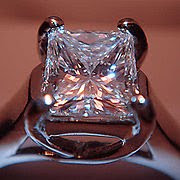
Princess cut From Wikipedia, the free encyclopedia


The Princess cut is the second most popular cut shape for diamonds, next to a round brilliant. The face-up shape of the princess cut is square or rectangular and the profile or side-on shape is similar to that of an inverted pyramid with four beveled sides. The princess cut is a relatively new diamond cut, having been created in the 1960s. It has gained in popularity in recent years as a more distinctive alternative to the more popular round brilliant cut, in which the top of diamond, called the crown, is cut with a round face-up shape and the bottom, called the pavilion, is shaped similar to a cone. A princess cut with the same width as the diameter of a round brilliant will weigh more as it has four corners which would otherwise have been cut off and rounded to form a round brilliant. The princess cut is sometimes referred to as a square modified brilliant. However, while displaying the same high degree of brilliance, its faceting style is quite unique and completely different from that of a round brilliant. The Princess cut had its origins in the early "French" cut, having a step-modified "Double-French" or "Cross" cut crown and a series of unique, chevron-shaped facets in the pavilion which combine to give a distinct cross-shaped reflection when the stone is viewed directly through the table. Effectively, the Princess cut combines the high degree of light return of a round brilliant cut with a distinctive square or rectangular shape.

The square princess cut diamond is usually slightly cheaper than round brilliant cut diamonds of the same carat weight because it retains about 80% of the rough diamond, as opposed to the round brilliant which retains only about 50% of the rough. The ability to retain more crystal weight makes this shape popular amongst diamond cutters.

Accredited Gem Appraisers (AGA) and American Gem Society Laboratory (AGSL) and European Gem Laboratories-USA (EGL-USA) are currently the only labs that grade the Princess cut for cut. There is no universal definition of what measurements make an ideal princess cut diamond and many diamond manufacturers market ideal diamonds with differing facet patterns and angles as "ideal cut". In contrast to the AGSL, AGA, and EGL-USA the Gemological Institute of America (GIA) has stated that there is not enough industry consensus or empirical data to specify cut grading standards for Princess cut diamonds and to do so is at the risk of consumers who may be deceived by diamonds accompanied by unqualified Ideal or Excellent cut grades.

The name "Princess Cut" was originally used in connection with another diamond cut, otherwise known as the "Profile" cut, designed by Arpad Nagy a London cutter in 1961. The same name was later used and made popular by Ygal Perlman, Betzalel Ambar, and Israel Itzkowitz in Israel in 1979. A similar cut with only 49 facets, as opposed to the original 58 facets of the princess cut, was later branded the "Quadrillion" and initially distributed by Ambar Diamonds in Los Angeles. Three years of optical research yielded a square stone with faceting similar to that of a round brilliant cut diamond.